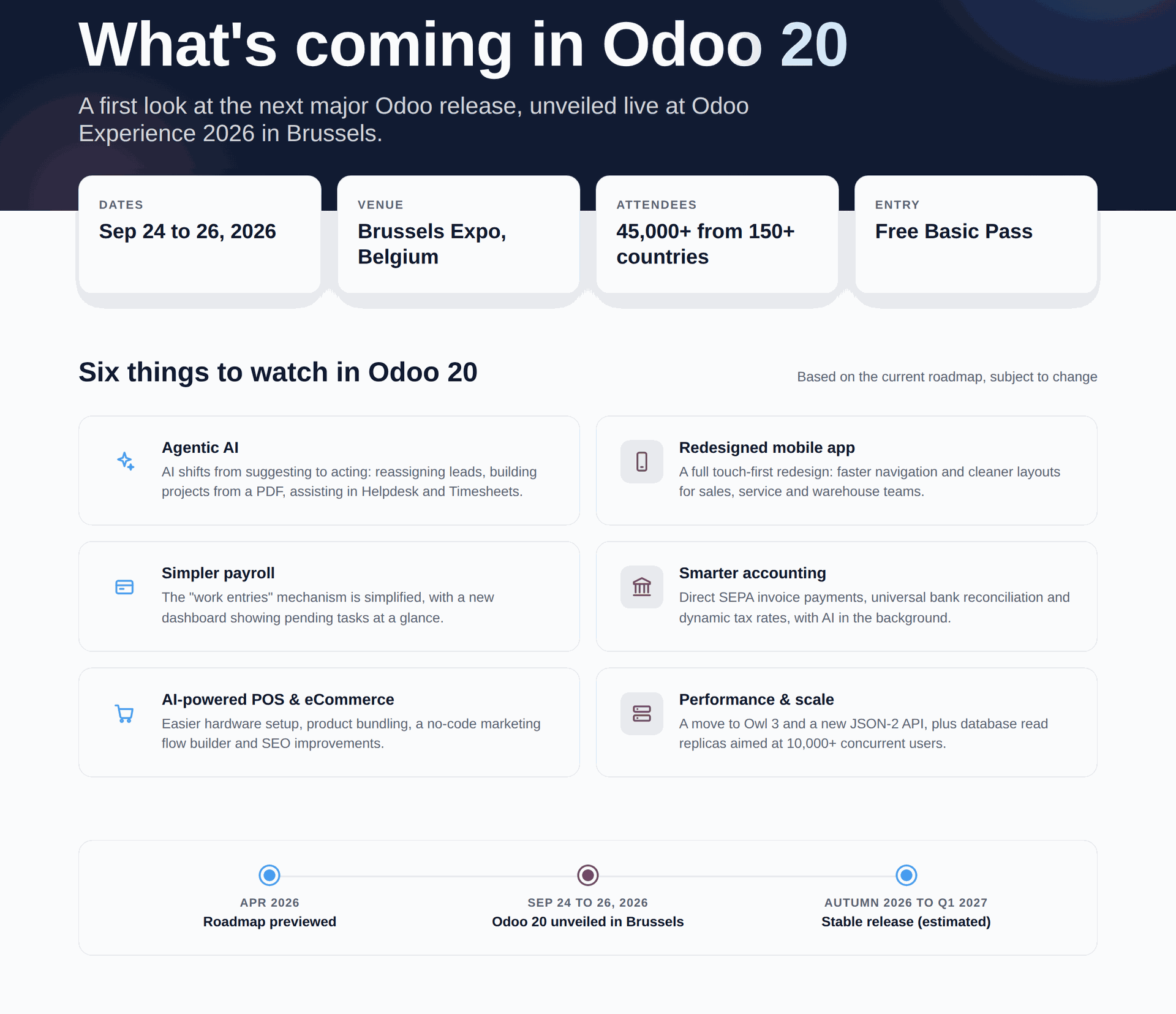
Odoo pushes its platform forward with a major release once a year, and this year is no exception. The new major version, Odoo 20, is set to make its live debut at the world's biggest Odoo conference: Odoo Experience 2026, taking place September 24 to 26, 2026 at Brussels Expo in Brussels. If you work with Odoo, are planning a move to it, or just want to know where the ERP world is heading, now's a good time to take stock of what's coming.
One important caveat up front: Odoo keeps its roadmap close to the chest until the last moment, so most of what follows is based on preliminary information gradually revealed by Odoo and its partners (for example at Odoo Partner Days) and on what partner companies across the community have been noticing. The final feature set may still change before September.
When and Where Odoo 20 Will Actually Show Up
The release itself is traditionally tied to the conference. Odoo has kept the rhythm for years of unveiling each new major version on the Odoo Experience stage. This year that means September 24 to 26, 2026. Expect a working demo and preview across modules (Accounting, eCommerce, CRM and others) at the event, while the fully stable version for production use should follow over the following months. Partner estimates vary somewhat, ranging from autumn 2026 to the first quarter of 2027, so if you're planning an upgrade, build in a safety margin rather than betting on an exact date.
For companies still running older versions, this release carries one more practical consequence: launching Odoo 20 typically closes out support for the oldest still-supported version, currently Odoo 17. That means the end of security updates for databases still running on it, which is a good reason to open the upgrade conversation now rather than waiting until support runs out.
AI That No Longer Just Advises, It Acts
The most prominent theme of the upcoming release is AI's shift from advisor to autonomous agent. Until now, AI in Odoo has mostly suggested ("try this") or searched; in Odoo 20 it should be able to act directly across modules, for example automatically reassigning inactive CRM leads, assembling a project straight from an uploaded PDF, or working as an assistant inside Helpdesk and Timesheets. Enterprise customers should also get native support for an MCP server, a standardized interface for connecting AI agents to company data, plus the ability to issue commands or search the database in natural language.
In other words, AI is moving from a "nice add-on" toward genuine automation of the routine work your team does every day.
A New Face for Mobile and Field Teams
The mobile app is due for a full touch-focused redesign: faster navigation, cleaner screen layouts and smoother performance. Sales reps, field service technicians and warehouse staff who work with Odoo mainly from a phone or tablet will notice the difference most.
Simpler Payroll and Accounting That Understands Your Business
In Payroll, the current, fairly complex "work entries" mechanism is set to be simplified in favor of a more direct calculation and a new dashboard showing pending tasks at a glance. Accounting gains support for direct SEPA invoice payments from within Odoo, unified (universal) reconciliation across banks, and dynamic tax rates. The goal is for accounting to be manageable even by someone who isn't a professional controller, with AI assistance running in the background.
Sales, POS and eCommerce Get an Extra AI Layer
Point of Sale should bring easier hardware integrations, automatic product bundling and new payment gateways. The website and eCommerce modules are getting SEO improvements and a new visual flow builder for marketing automation, letting you set up campaigns without writing code. Another new feature is the ability to buy phone numbers in more than 100 countries directly inside Odoo, which is handy for companies running international call centers or sales teams.
Under the Hood: Performance and Technical Foundations for Larger Companies
Odoo 20 also brings changes an everyday user won't see directly but will feel in system performance. That means a move to Owl 3 (Odoo's internal frontend framework) and a new JSON-2 API, which is set to gradually replace the older XML-RPC and JSON-RPC interfaces. Companies with custom integrations should keep an eye on this well ahead of time. For larger installations, there's also mention of database read-replica support, splitting the load between writes and reads, with the aim of comfortably handling more than 10,000 concurrent users.
Why It's Worth Coming to Brussels in Person
Reading about new features is one thing; seeing them live and trying them out on-site is another. Odoo Experience 2026 (September 24 to 26, Brussels Expo) is the largest event of its kind in Europe. Organizers expect more than 45,000 attendees from 150+ countries, 400+ exhibitors, and hundreds of talks and masterclasses over three days. The Basic Pass is free, with paid Premium and CEO passes also available for those who want more networking and a more exclusive program.
For a company that works with Odoo or is considering it, this is a unique chance to see Odoo 20 firsthand before its official release, get direct feedback from the product teams, and plan your own upgrade based on real information rather than preliminary reports.
We won't be missing Odoo Experience 2026 either. 26HOUSE will be attending together with our partners from BOP Alliance (Best Odoo Partners Alliance), so if you're planning to be there too, we'd love to meet in person and talk through what Odoo 20 means specifically for your business.
And if you're currently running an older version of Odoo, now is a good time to open the upgrade conversation, not right before support ends. Get in touch with 26HOUSE, we're happy to walk you through what an upgrade to Odoo 20 would look like for you, what it would bring, and how to plan a smooth transition, whether we meet in Brussels or at your own office.
Odoo 20 is coming, and it's worth planning for.
Contact us and get started with Odoo upgrade now.